
Impact Revenue Investments program - frequently asked questions
Eligibility
Eligible applicants are required to demonstrate that their organisation is a genuine social enterprise by providing evidence of one or more of the following:
-
- Social Traders certification* (https://www.socialtraders.com.au/social-enterprise-certification)
- People and Planet First (PPF) verification* (Verification | QSEC)
- Registration via the Office of the Registrar of Indigenous Corporations, certification with Supply Nation, or verified membership with the Queensland Indigenous Business Network (QIBN), and ability to demonstrate how they deliver outcomes as part of their business operations.*
* If your organisation is proposing to obtain any of the above certifications, verifications, registrations or memberships, you may note this in your application. These arrangements do not need to be finalised for Stage 1 consideration, provided the relevant application process has commenced. However, this process will need to be completed before any funding decision can be made in Stage 2.
Eligible applicants must also be:
- either
- operating in Queensland with a physical presence in Queensland and generating a social benefit which occurs in Queensland; or
- not operating in Queensland, but operating interstate and able to demonstrate within 6 months of contract commencement that it (a) has established a physical presence in Queensland, (b) is operating in Queensland, and (c) is delivering social benefit in Queensland
- able to demonstrate potential for sustainable growth in trade revenue and social impact (this might be demonstrated, for instance, through a history of trade revenue growth or by having secured investment, land, or other capital that is expected to unlock trade revenue growth within a year of contract commencement and be profitable, or have the potential to be profitable)
- able to demonstrate good governance by having an established independent board in place or by providing a method statement that demonstrates transparent, accountable, and effective decision-making structures that balance social mission, financial sustainability, and stakeholder interests (for detail on what comprises an adequate ‘method statement’, see further FAQs below).
See Section 3.2 Eligibility in the guidelines for the full list of eligibility criteria.
- Individuals and sole traders cannot apply.
- Charities and not-for-profit organisations can apply if they are genuine social enterprises and meet the IRI program eligibility requirements outlined in Section 3.2 of the guidelines. This includes social enterprises that are subsidiaries of not-for-profit organisations.
- If your not-for-profit organisation is not currently operating a social enterprise, but is looking to expand existing activities to include social enterprise, you are not eligible for this round of IRI.
Yes, to be eligible for funding, the social enterprise can be operating under a parent organisation’s ABN. However, the social enterprise will need to evidence that they maintain independent financial accounts alongside meeting the eligibility criteria outlined in the Guidelines (see related FAQ on who is eligible).
No, there is no minimum or maximum trading revenue that organisations must meet to be eligible.
While trading revenues do not need to be generated in Queensland, impact must occur in Queensland. Entities will be asked to report on both trading revenues and impact. For those social enterprises who are currently operating interstate but intend to operate in Queensland, they will need to demonstrate that they have established a physical presence, are operating, and delivering a social benefit in Queensland within six months of contract commencement before receiving the first upfront payment.
Yes, if they are a genuine social enterprise aligned to the IRI program eligibility requirements (see related FAQ on who is eligible) and are not a sole trader or individual entity. Organisations in the start-up phase that do not have a history of trade revenue growth will still need to demonstrate potential for sustainable growth in trade revenue and social impact in Queensland.
Early-stage social enterprises may also be interested in our Ready to Launch program which will open later in 2026. This will provide seed capital and capability support to help social entrepreneurs navigate early growth with co-investment from aligned partners. This will include a focus on early-stage organisations that leverage innovation, or technology supported services or products that provide social benefit to Queenslanders. Sign up to our mailing list to be notified of when this program opens.
To be eligible to apply your organisation needs to be:
- operating in Queensland with a physical presence in Queensland and generating a social benefit which occurs in Queensland, or
- operating interstate and not in Queensland but can demonstrate that it will establish a physical presence in Queensland, be operating in Queensland and delivering social benefit in Queensland within 6 months of contract commencement.
This does not mean, however, that your primary headquarters need to be located in Queensland. For example, if your organisation has staff working on the ground in Queensland, you are eligible to apply for the IRI program. The IRI program is targeting revenue and impact growth in Queensland.
Program Rounds
This current round, Round 2, maintains the same objective as Round 1, which is to help social enterprises grow, become more financially sustainable, and increase their social impact.
Targeted refinements have been made, informed by consultation and sector feedback, to clarify eligibility and improve program efficiency. Key changes from Round 1 include:
- adding verified membership of the Queensland Indigenous Business Network (QIBN) as a pathway for incorporated Indigenous owned and operated organisations to participate
- allowing interstate organisations who are not currently operating in Queensland to apply, provided they can demonstrate that they will establish a physical presence, operate, and deliver social benefit in Queensland within six months of contract commencement
- streamlining trading revenue calculations and payment cycles by moving away from six monthly reporting and payments to annual reporting and payments
- streamlining the assessment framework.
Yes, the intention is to run three rounds of IRI, with Round 1 completed, and Round 3 planned to open in 2027. OSI reserves the right to alter the eligibility criteria, application process, and priority impact areas for future rounds.
Funding
The IRI program focuses on supporting organisations that create a positive social impact in Queensland. Priority will be given to applications that align with the following impact areas identified in the Roadmap:
- ensuring quality jobs for disadvantaged Queenslanders
- helping vulnerable young people thrive, and reducing crime rates
- addressing the drivers and impacts of addiction and mental health issues
- reducing the number of children in out-of-home care, especially residential care
- improving women’s safety – preventing family and domestic violence and lessening its impacts
- reducing homelessness and increasing social and affordable housing
- creating place-based initiatives to enable all communities to thrive
- other opportunities to generate high social impact for Queenslanders (for example, food security).
IRI funding is untied, allowing organisations to flexibly allocate the funding towards any operational or capital expenses that will help grow revenues and amplify impact. Examples include, but are not limited to:
- salaries and wages for staff
- intermediary services such as accounting, legal, impact measurement, or marketing support
- administrative costs like rent, utilities, or insurance
- technology upgrades, software, or equipment to improve efficiency
- purchasing or upgrading physical assets, such as buildings, vehicles, or machinery
- developing infrastructure to support service delivery or business growth
- investing in tools or resources to enhance your organisation’s capacity.
While the funding can be flexibly used to support growth, it must be applied to the purposes of the organisation and cannot be used for private benefit. Examples of private benefit include excessive remuneration or dividends, purchase or improvement of assets for primarily private use, or the use of funds to increase private business value. The organisation must report on how funding is applied and may be required to refund any funding that is misapplied.
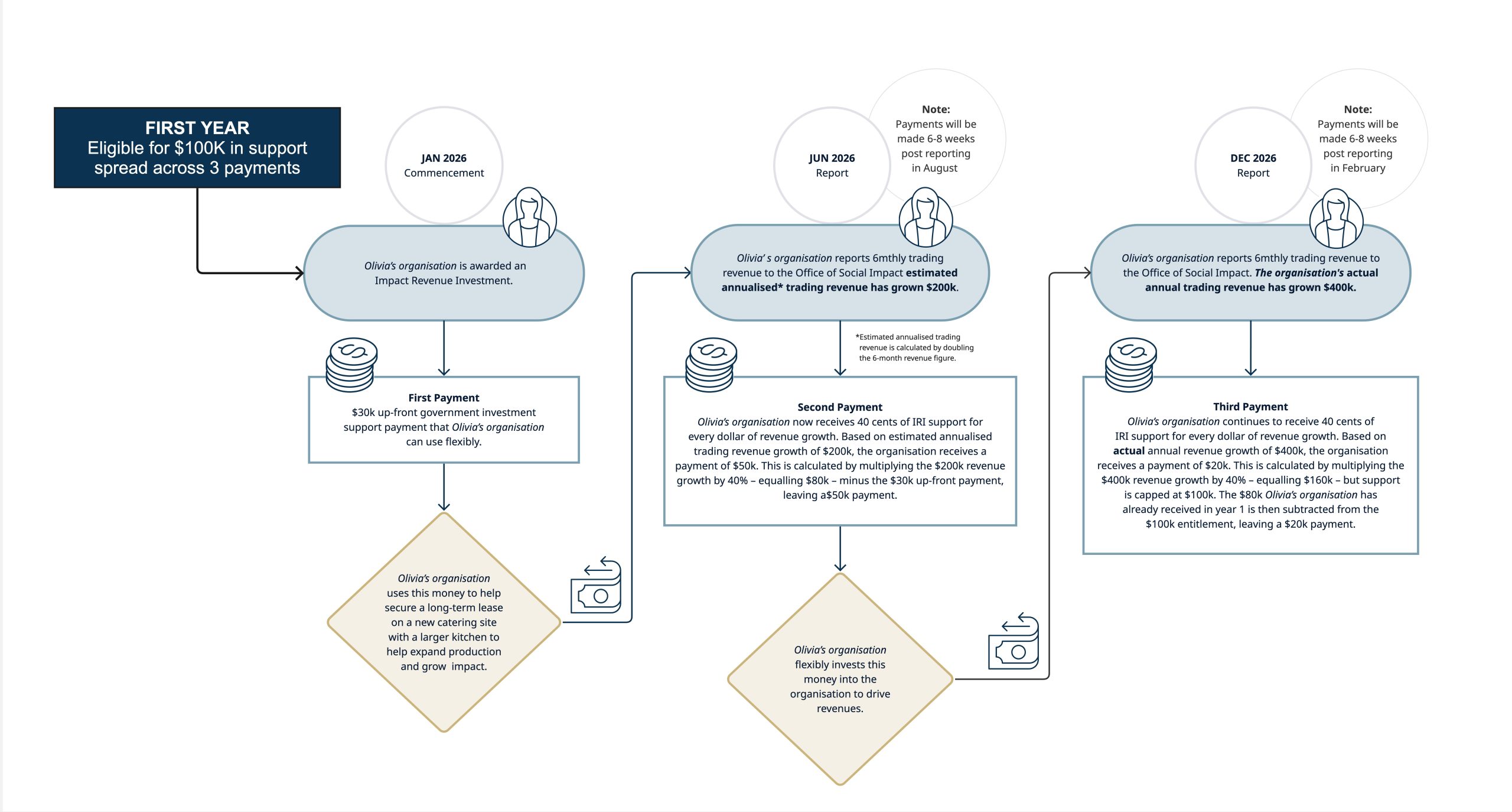
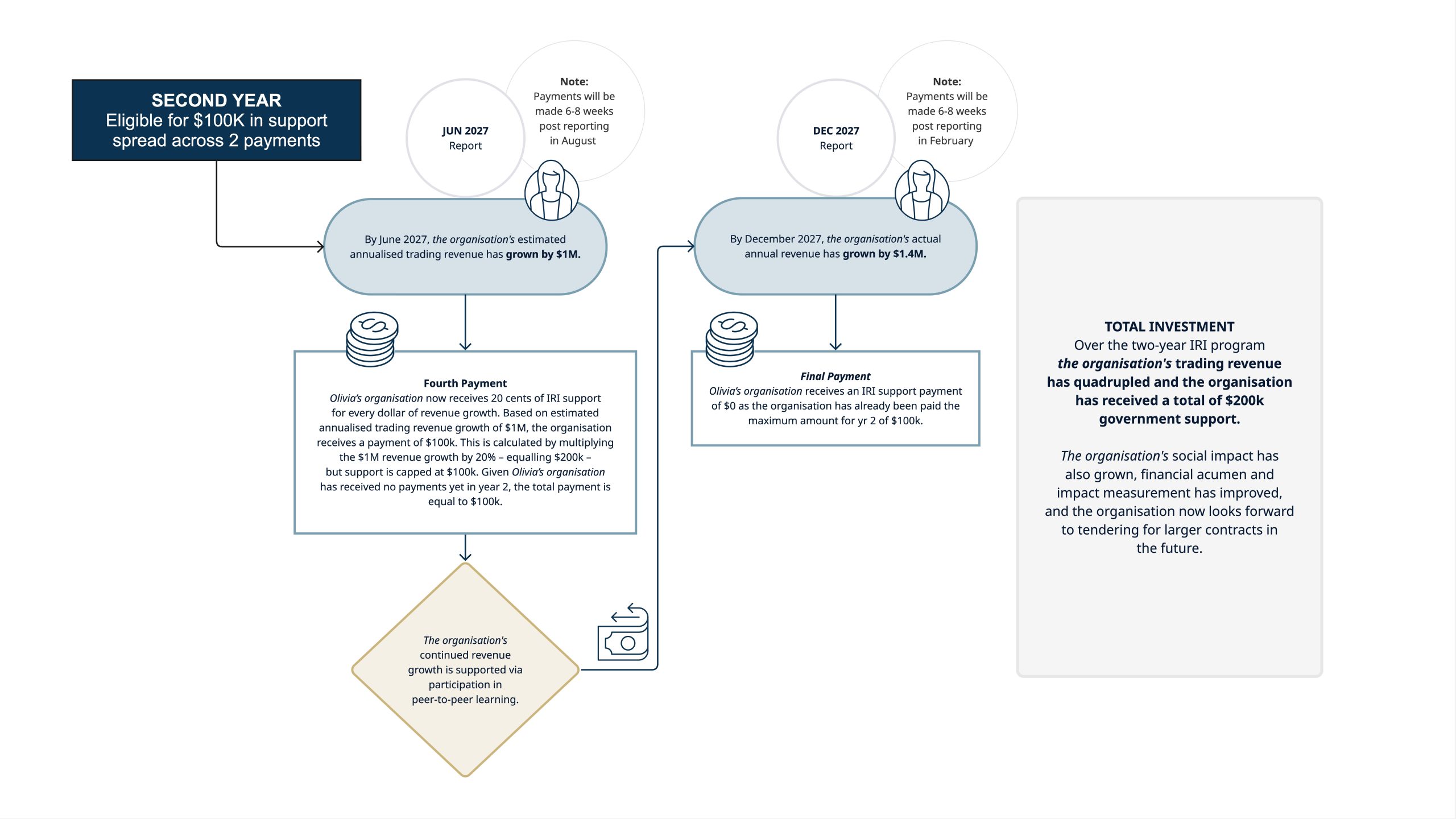
Eligible social enterprises can receive up to $200,000 in total funding over three financial years, with an initial upfront payment of $30,000 paid in July 2027 to provide working capital, a second payment of up to $70,000, based on trading revenue growth during the 2027–28 financial year ($4 in funding for every $10 in revenue growth; with total funding in 2027-28 capped at $100,000, including the upfront payment of $30,000), expected to be paid by September 2028, and a third payment of up to $100,000, based on trading revenue growth during the 2028–29 financial year ($2 in funding for every $10 in revenue growth; with total funding in 2028-29 capped at $100,000), expected to be paid by September 2029.
For further detail around how individual payments are calculated, refer to ‘How does IRI work in practice?‘.
Yes, structured capability support will be provided as part of the IRI program to ensure social enterprises have access to both the financial and non-financial support necessary to succeed.
No, the IRI program is a competitive process. All applications will be assessed against the eligibility and assessment criteria outlined in the Guidelines.
Application process
If you have an independent board, you will not be required to submit any documentation. If you do not have an independent board, you will be required to attach a method statement about your organisation’s governance (for detail on what comprises an adequate ‘method statement’, see further FAQs below).
In Stage 1, applicants need to provide basic information about their organisation, including its financial history, potential for revenue growth, and its social impact areas. This information will be submitted without supporting evidence for the purpose of Stage 1 and will be assessed against the criteria outlined in the Guidelines. Applicants who are shortlisted in Stage 1 will be invited to submit an application in Stage 2.
In Stage 2, applicants will be asked to provide additional details and evidence to support the claims made in Stage 1. This could include documents like: financial statements; impact assessments; and registration, certification, verification, or membership documentation, as well as other information and evidence to inform the assessment of your organisational capability, financial viability, revenue growth potential, and social impact quality. The Stage 2 assessment will use this evidence, along with the Stage 1 information, to decide which applications will be recommended for funding.
OSI will provide:
- public information sessions co-hosted by the Queensland Social Enterprise Council in the first two weeks of October. Links to register your attendance are available on the OSI Impact Revenue Investments web page
- updates to the FAQs
- a dedicated inbox for questions – impactrevenueinvestments@treasury.qld.gov.au.
A method statement for governance is an outline of principles, processes, and practices your organisation has adopted to ensure it operates effectively, sustainably, and with clear accountability, transparency, and ethical behaviour. Elements to consider including in your method statement include:
- mission and purpose: are your organisation’s mission and purpose clearly defined and how does your organisation ensure its activities and decision making are aligned with these?
- accountability and transparency: what mechanisms and processes does your organisation follow to report on finances, performance, and impact?
- leadership and decision making: in the absence of an independent board, what are the decision-making structures and processes within your organisation?
- regulatory and ethical compliance: what are the means by which your organisation adheres to relevant laws, regulations, and ethical standards?
- financial sustainability: what financial management practices does your organisation follow, including those relating to budgeting, risk management, and diversification of income streams?
A method statement can take many forms, and there are no specific requirements on how the method statement should look. However, you can use the method statement template to assist. This is not mandatory and is intended as a guide only.
No, there should only be one application per certified social enterprise.
Application outcomes
Trading revenue will need to be reported every 12 months to determine how much funding you are eligible to receive under the IRI program via audited financials.
You will also be required to report every 12 months on the social impact that your organisation has created in Queensland as a result of the government support. However, government payments will be made on the basis of revenue growth, not social impact.
More information will be provided to applicants who are invited to apply to Stage 2.
Unsuccessful applicants will be notified following both the Stage 1 and Stage 2 assessment process.
Trading revenue
Trading revenue is the gross revenue generated from the sale of goods or services as part of operating business activities minus any discounts or refunds provided. This revenue is distinct from grants, donations, or other forms of similar funding, as it is earned through commercial transactions. For the purpose of IRI, trading revenue excludes income earned from donations, grants, interest, dividends, inter-company transfers, other forms of passive income, and profits on the sale of assets.
For the purpose of IRI, grants are defined as financial assistance payments provided by a government, philanthropy, or other funding organisation to support the achievement of specific objectives or outcomes. These payments are characterised by a transfer of funding without a direct and approximately equal exchange of goods and services. Payments that are considered a ‘fee for service’, such as NDIS payments, or involve a contractual arrangement for the delivery of specific services or products, are excluded from this definition and can be included as part of trading revenue.
All successful applicants will be required to enter into a funding agreement with the State, which sets out the terms upon which assistance will be provided, including reporting requirements. Inability to deliver social impact in Queensland in the areas identified during the application process will be addressed as part of the contractual arrangements.
Case study
Case study – Nourish & Connect Catering
Nourish & Connect Catering is a social enterprise based in Ipswich that provides free meals through its ‘Eat and Connect’ food vans program to people experiencing or at risk of homelessness across South-East Queensland, while also providing commercial catering services for businesses, government agencies, and community organisations. Nourish & Connect Catering:
- currently generates $600,000 in annual trading revenue, with all profits reinvested to grow its social impact
- has the opportunity to triple trading revenue over the next two years but requires funding to expand
- has accreditation with both Social Traders and People and Planet First and operates with an independent board
- as a social enterprise that delivers impact in Queensland, and with potential for growth, Nourish & Connect is successfully awarded an Impact Revenue Investment from the Queensland Government.